Today, the Revolving Door Project released a new99-page reportoutlining a broad array of policies the administration can pursue to protect the climate and crack down on corporate polluters.The report, and atwo-page summaryof some of the highlights, are attached.
The report covers a broad slate of policies the administration should pursue under existing responsibilities assigned by previous Congresses without needing any additional Congressional authorization. These include actions at the Environmental Protection Agency and Department of Interior, as well as agencies whose climate potential is less broadly recognized, including the Department of Justice, financial regulatory agencies, Department of Energy, and foreign policy apparatus.
“Climate change threatens the basic foundations of society. It is the very definition of a whole-of-government problem, which means every single federal agency should apply its existing powers creatively and aggressively toward the problem,” said Revolving Door Project Research Director Max Moran. “Alone, these executive branch policies are wildly insufficient to the task of getting America to meet its climate goals. But all of these policies are necessary components of the puzzle, and represent the lowest-hanging fruit in terms of climate action.”
The report also highlights the urgent need to rebuild the federal civil service in order to expand state capacity to implement climate policies. The report shows how even minimal interventions under the Clean Air Act, Clean Water Act, and other longstanding statutes yield enormous dividends for the nation in terms of lessened healthcare needs and longer lifespans.
“This report documents in detail an array of policy options the Executive Branch currently has at its disposal to combat the climate crisis,” said Aidan Smith, a Senior Advisor at Data for Progress who contributed to this report in a personal capacity. “Strong rulemaking in a number of issue areas, from efficiency standards to electrical generation, stands to help reduce emissions and contribute to the development of America’s clean energy sector.”
The pursuit of net zero healthcare risks targeting the poor and exacerbating existing unfair heath inequalities unless careful consideration is given to the re-allocation of healthcare resources. A group of global health researchers, writing in the Journal of the Royal Society of Medicine, say that as with pandemic measures, the burdens of climate impacts and cutting emissions are not equally shared.
The NHS in England has committed to ambitious net-zero targets – an 80% reduction in emissions under its direct control by 2028-2032 and across the supply chain by 2036-39, reaching net zero by 2040 and 2045 respectively.
According to the researchers, the most deprived people have poorer health, a lower life expectancy and consume a greater amount of health services. Given healthcare consumption is the ultimate driver of healthcare emissions, they write, this has important implications in terms of justice for the pursuit of net zero healthcare.
Lead author Dr Anand Bhopal, a PhD research fellow at the Bergen Centre for Ethics and Priority Setting, said: “Lifetime health costs among the poorest people are 10-20% higher than the least deprived. It seems likely that individual healthcare carbon footprints also follow a social gradient, with emissions highest amongst the worst-off.”
According to Dr Bhopal and his colleagues, healthcare carbon emissions represent almost a fifth of the per capita healthcare carbon footprint among the poorest people, compared with under a fiftieth among the richest.
The net zero agenda involves, in part, transforming how the NHS delivers care and changing the behaviour of individuals. Reducing carbon emissions within the healthcare system involves trade-offs, write the researchers, since a re-allocation of resources may displace spending from more cost-effective health interventions.
The researchers consider if those with the greatest means and total emissions caused outside the healthcare system should shoulder the responsibility to reduce their carbon footprint. They give the example of a return flight from London to New York which incurs four times the NHS’ per capita carbon footprint or almost the annual total emissions of an individual in the poorest decile.
“Those who depend on the public healthcare system, and who risk the most if health gains are sacrificed due to already existing health inequity, may find it doubly unfair to carry the burden of reducing carbon emissions,” added Dr Bhopal.
IMAGE: HIGHER HEALTHCARE PRICES DROVE 38% OF AMERICAN ADULTS – REPRESENTING AN ESTIMATED 98 MILLION PEOPLE – TO EITHER DELAY OR SKIP TREATMENT, CUT BACK ON DRIVING, UTILITIES, AND FOOD, OR BORROW MONEY TO PAY MEDICAL BILLS IN THE LAST SIX MONTHS, ACCORDING TO A NEW SURVEY CONDUCTED BY WEST HEALTH AND GALLUP.view more
CREDIT: WEST HEALTH - GALLUP HEALTHCARE AFFORDABILITY STUDY THE GALLUP PANEL: JUNE 2-16 2022. N=3.001
WASHINGTON, D.C. — Aug. 4, 2022 — Higher healthcare prices drove 38% of American adults – representing an estimated 98 million people – to either delay or skip treatment, cut back on driving, utilities, and food, or borrow money to pay medical bills in the last six months, according to a new survey conducted by West Health and Gallup. The survey was conducted in June 2022, the same month inflation reached 9.1%, a new 40-year high.
The percentage of people making these kinds of tradeoffs was higher in lower-income households, but higher earners were not immune. While more than half of households earning less than $48,000 a year made spending cuts, nearly 20% of households earning more than $180,000 a year were forced to cut back too. Women under the age of 50 also cut back on medical care and medicine at higher rates than their male counterparts (36% to 27%, respectively) and much higher than men generally (22%).
“People have been making tradeoffs to pay for healthcare for years. Inflation has only made things worse as people are also now struggling with the high price of gas, food, and electricity,” said Timothy A. Lash, President, West Health. “However, unlike those expenses, Congress has the power right now to reduce healthcare prices, particularly for prescription drugs. Legislation is on the table.”
Healthcare inflation, which stood at 4.5% in June 2022, was half the overall inflation rate, which spiked to 9.1% in June, primarily because of rising prices for gas, food, and rent.
Most Americans are not even thinking about how inflation may increase healthcare prices given the spikes in gas and food. When asked, “For which one of the following expenses do you expect costs to rise the most in the next six months?”, 43% of respondents cited gas, followed by food (34%). Healthcare was mentioned by only 3% of respondents.
Aside from the tradeoffs that Americans are making to afford healthcare in the current inflationary environment, one in four (26%) say they simply avoided medical care or purchasing prescription drugs altogether because of higher prices and were either unable or unwilling to divert funds from somewhere else to pay for it.
The future does not look bright for these Americans in terms of relief at the pharmacy counter. Overall, 39% report being “extremely concerned” or “concerned” about being unable to pay for care in the next six months, including 33% of Democrats, 44% of Republicans and 42% of independents.
In addition to focusing on the healthcare cost challenges Americans face, the survey looked at how inflation was changing consumer behaviors. Driving less and cutting back on utilities were the top ways Americans tried to cope with higher prices.
“Inflation is hollowing out consumer spending habits across an array of areas,” said Dan Witters, senior researcher at Gallup. “What is found just under the surface is that after gas and groceries, the role of inflation in reducing the pursuit of needed care is large and significant. And the rising cost of care itself, which is originating from an already elevated level, is having an outsized impact on lessening other forms of spending, compounding the problem.”
Little Confidence Exists in Federal and State Governments to Curtail Costs
Irrespective of race, gender, income or political identity, Americans hold little confidence in their elected representatives to Congress or their own state government to slow rising costs. Three in five adults (59%) are “not at all confident,” and another 35% are “not too confident” that their own members of Congress will take action to lower healthcare costs in the coming months. Only 6% are “somewhat” or “very confident.”
When viewed through a political lens, Republicans and independents report elevated levels of concern about future healthcare affordability, but Americans in all three political identity groups (more than nine in 10) are “not at all confident” or “not too confident” that members of Congress will take action.
Well-designed legislation that supports the economic future of families, workers, and children while at the same time reducing deficits would have little if any effect on aggregate demand for goods and services that would raise inflation concerns. Moreover, legislation that includes measures to improve access to health coverage and child care, to provide more income support to help the lowest-income families with children to cover basic costs, and to address climate change would deliver substantial benefits.
It would have little, if any, impact on aggregate demand. Recent high inflation reflects strong growth in the demand for goods and services bumping up against constraints on the supply of those goods and services. The result has been rising prices, which the Federal Reserve must address. However, a modest-sized, targeted economic package would spread investments relatively evenly over the next decade and include revenue increases and spending reductions — similarly spread over the decade — large enough to fully pay for the investments and also reduce the deficit. In an economy with cumulative gross domestic product (GDP) over the coming decade of roughly $300 trillion, such a package would likely spend less than 0.5 percent of GDP and include enough offsets to reduce the deficit, and therefore would not have a noticeable effect on aggregate demand.
It would come at a time when the expiration of pandemic-related relief and stimulus measures is causing a significant drag on aggregate demand. This year the economy began to face fiscal headwinds from the expiration of past measures that will dwarf any inflationary pressure from a well-designed and paid-for economic package. Federal, state, and local tax and spending policies added 5.35 percentage points to GDP growth between the first quarter of 2020 and the first quarter of 2021, according to the Hutchins Center at Brookings. But in the four quarters since then, the waning of tax and spending measures subtracted 2.72 percentage points, Hutchins estimates — a swing of over 8 percentage points — and such subtraction will continue into 2023. Going forward, this drag is a force reducing inflationary pressures.
The impact of this swing in fiscal policy will vastly outweigh any impact from a well-designed economic package that reduces the deficit.
Analysts in thisWall Street Journal article drew similar conclusions:
Looking just at federal policies, David Mericle, chief U.S. economist at Goldman Sachs says, “By the fourth quarter of 2021, the various Covid-19 relief packages enacted since 2020 had boosted the level of U.S. GDP by just under 6 percentage points…[but] by the end of 2022 that boost will shrink to a little less than 2 percentage points, … equivalent to 4 percentage points of drag on economic growth compared with what would have been if pandemic programs offered the same support as in 2021.
Joseph LaVorgna, chief economist for the Americas at Natixis, forecasts even lower growth, of around 1.5%, mostly because of waning fiscal support. “I think it is fair to say that the fiscal shock is going to be in historic proportions,” Mr. LaVorgna said.
Similarly, Federal Reserve Chair Jerome Powell pointed out in January that “fiscal policy is going to be less supportive of growth this year.” In other words, the economy can still grow but that growth will come from non-government demand, not fiscal policy.
By promoting growth over the long term, it could reduce inflationary pressure. Over time, investments that increase the economy’s capacity to produce goods and services would lead to higher productivity and stronger non-inflationary growth. Policies under discussion for an economic package, such as improved access to health care and child care and improved income support for low-income families with children, have been shown to have long-term benefits. For example, child care can increase the labor supply in the short term and improve children’s longer-term outcomes in ways that increase future productivity. Also, clean-energy investments can mitigate the economic costs of climate change. Seventeen Nobel Laureates in Economics have explained how future-oriented investments and tax reform that makes the tax system more equitable would ease longer-term inflationary pressures.
The Federal Reserve has primary responsibility for addressing inflation and is taking the steps necessary to do so, including yesterday’s announcement of a half-point increase in interest rates. An economic package of modest size that addresses critical needs and reduces the deficit would not hamper the Fed’s efforts. It would, however, have a large and positive impact on the lives of the people who receive the benefits.
A report by UCLA psychologists and RAND economists has identified an effective way to reduce the number of divorces among lower-income Americans: Raise the minimum wage.
The study, which is published in the Journal of Marriage and Family, is the first to analyze the effects of states’ minimum wage increases on the rates of marriage and divorce among low-wage earners.
“When policymakers think about ways of helping disadvantaged families, there has been a general tendency to try teaching them things like better communication or coping skills,” said UCLA psychology professor Benjamin Karney, the study’s lead author. “The assumption that the consequences of income inequality can be managed this way has been proven wrong again and again.
“Luckily, there are other, more direct avenues to improving the lives of disadvantaged families, and one is to pursue policies that improve their lives in concrete ways.”
The study is especially timely. In March, the Republican subcommittee of the Senate Joint Economic Committee published a report expressing members’ continued commitment to communication skills education programs as a way to strengthen marriage among low-income Americans. Over the past two decades, the federal government has allocated nearly $1 billion toward such programs.
But Karney said those initiatives are expensive and have been proven in several large studies to be ineffective.
The UCLA–RAND study shows that when states increased their minimum hourly wage by $1, divorce rates declined by 7% to 15% over the next two years among men and women earning low wages — including but not limited to those earning minimum wage.
The researchers also found that a $1 per hour increase in a state’s minimum wage reduced marriage rates by 3% to 6%. When younger low-wage earners earn more, they often delay marriage, rather than forgo marriage entirely, said co-author Thomas Bradbury, a UCLA psychology professor.
“Raising the minimum wage appears to bring the marital timing of low-wage earners more in line with the timing of more affluent people, who tend to marry at older ages,” he said, adding that later marriages are less likely to end in divorce.
Both changes — lower divorce rates and later marriages — are likely to strengthen low-income families, and the effects that occur after minimum wage increases are substantially larger than the effects of the federal programs on communication and coping skills, the researchers report.
“When the lives of poorer families get easier — that is, when they can be less poor — relationships within the family get easier as well, without anyone needing to be taught anything,” Karney said. “Any policies that address income inequality are likely to have measurable benefits for family stability.”
The researchers analyzed data from 2004 through 2015 from two independent monthly surveys: the Current Population Survey, a primarily telephone-based survey of approximately 60,000 households in populous areas, designed to be representative of the labor force, and the American Community Survey, a primarily mail-based survey of approximately 300,000 households in all geographic areas, designed to be representative of the broader population. The new analysis included only people between the ages of 18 and 35, who make up the majority of minimum wage earners.
Between 2002 and 2015, seven states — Alabama, Georgia, Kansas, North Dakota, Oklahoma, Texas and Wyoming — did not raise their minimum wages, except when required to do so by federal law.
“Financial considerations play a substantial role in whether couples consider their relationships worth maintaining,” Karney said. “Economic stress and financial strain predict less satisfying and less stable marriages, and higher levels of poverty and consumer debt predict a greater risk of divorce.”
Citing previous studies, the paper notes that when poorer people get married, they tend marry earlier and are about twice as likely to divorce.
In the study, the researchers defined low-wage workers as those earning $20 an hour or less. They write that the effects of increasing the minimum wage would be the same even if the definition of low-wage workers were based $16 an hour or less, or on certain tiers of federal poverty level guidelines.
The study’s co-authors are RAND economists Jeffrey Wenger and Melanie Zaber.
Specifically, 69% of corporations in Connecticut pay no state corporate income tax.
Anew Economic Policy Institute reportfinds that the effective state and local tax rate on corporate profits shrunk by between a third and a half between 1989 and 2017, resulting in a revenue shortfall between $43 billion and $57 billion.
Further, more than 60% of corporations pay no state corporate income tax in seven states—Connecticut, Colorado, Florida, Illinois, Michigan, Tennessee, and Wisconsin. And depending on the state, between 11% and 27% of corporations with over $1 billion in federal taxable income pay nothing or next to nothing in state corporate income taxes, according to the report.
This revenue shortfall has had real consequences for governments’ ability to provide basic services to their residents because state and local governments typically must match spending with revenue each year. To give a sense of the significance of revenue losses, state and local governments could essentially fully fund universal high-quality pre-kindergarten for all 3- and 4-year-olds with $57 billion.
The decline in tax revenue can be traced to a combination of state corporate income tax cuts, a rise in the share of corporate profits earned by S-corporations—which are exempt from most state corporate income taxes—and the ability of large, profitable corporations to exploit loopholes that allow them to minimize their tax bills.
Notably, the erosion of state corporate income tax revenue has nothing to do with corporations’ ability to pay. Corporate profits have risen even as corporate tax revenues have declined.
“Tax revenues are critical to the ability of state and local governments to provide basic services to their residents, including K–12 education, child care and elder care, maintenance of roads and bridges, and public health and safety, among others,” said Josh Bivens, director of research at EPI and author of the report. “However, in recent decades state and local policymakers have consistently allowed corporations to reduce their share of taxes. These policy decisions should be reversed to ensure profitable businesses pay their fair share in taxes.”
The report floats a number of reforms state legislators could implement to help stem these losses, including:
Raising statutory corporate income tax rates.
Passing legislation that forces corporations to provide a state-by-state accounting of their profits and taxes.
Taking steps to ensure corporations can’t simply evade taxes by setting themselves up as S-corporations or other new forms of businesses. Legislators can either tax these new business forms or raise personal income taxes progressively.
As the April 18 tax filing deadline approaches, 17 million adults not raising children at home and who do important jobs but for low pay are eligible toclaim an expanded Earned Income Tax Credit (EITC). Many of these adults, and all adults aged 19-24 (excluding students) and 65 and older, didn’t qualify for any EITC until the American Rescue Plan made them eligible in tax year 2021 — and they’ll again be ineligible starting this year unless policymakers extend this important fix to the EITC, an otherwise highly successful wage subsidy with bipartisan support.
The American Rescue Plan in 2021 raised the maximum EITC for workers without children from roughly $540 to roughly $1,500, and raised the income limit to qualify from about $16,000 to more than $21,000 for unmarried filers and from about $22,000 to more than $27,000 for married couples. It also expanded the age range of workers without children eligible for the tax credit to include younger adults aged 19-24 (excluding students under 24 who are attending school at least part time), as well as people 65 and over.
These changes made nearly 11 million workers without children newly eligible for the EITC; most will claim it when they file their 2021 tax returns this year (though claimants who miss filing a tax return this year still have three years during which they can file and claim their expanded credit). (See table below for details on these 11 million.)
In all, an estimated 17.4 million low-paid adults without children across the country will benefit from the expanded credit, including roughly 9.7 million white, 3.6 million Latino, 2.7 million Black, and 816,000 Asian workers. These adults work as cashiers, home health aides, child care workers, and in other roles crucial to people’s daily lives.
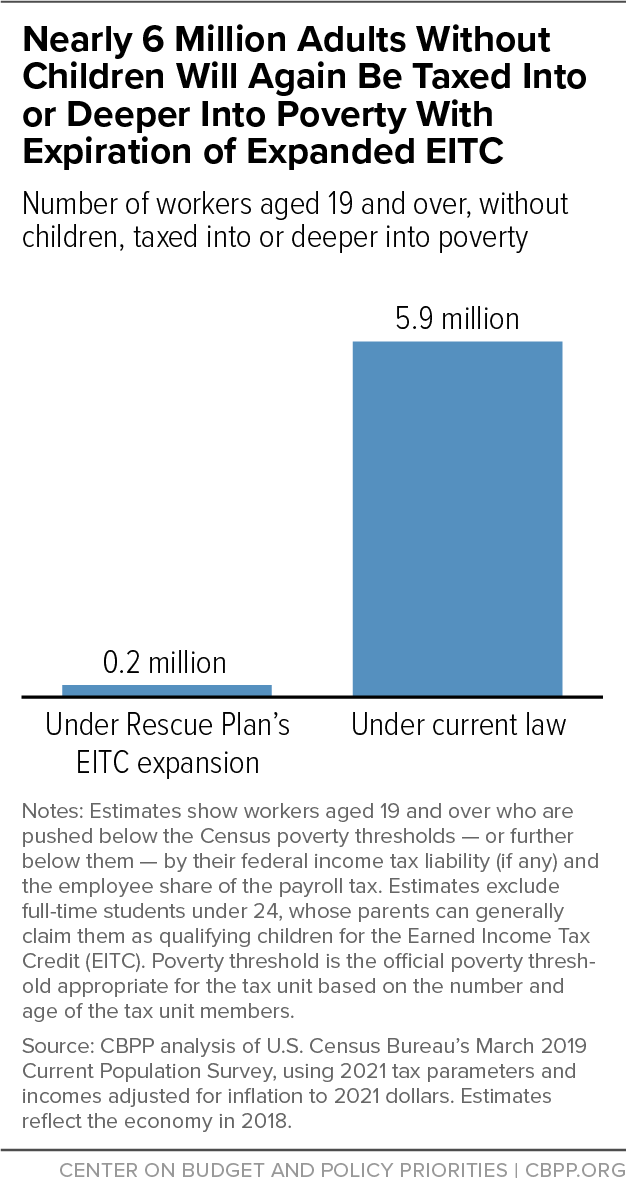
Among those benefiting from the Rescue Plan’s EITC expansions are nearly 6 million working adults aged 19 and older who aren’t caring for children and who will again be taxed into, or deeper into, poverty under current law because their EITC will be zero or paltry. (See graph.) This group includes about 3 million white, 1.3 million Latino, and 1 million Black workers (but excludes full-time students under age 24), many of them young and trying to gain a toehold in the labor market.
To see how the Rescue Plan will help this year at tax time, consider a 25-year-old single woman who worked roughly 30 hours a week throughout 2021 as a child care worker and earned about $9.50 an hour. Her annual earnings of $14,250 were just above the poverty line of $14,097 for a single individual. Without the Rescue Plan, federal taxes would have pushed her into poverty:
Some $1,090 — 7.65 percent of her earnings — was withheld from her paychecks for Social Security and Medicare payroll taxes.
When filing income taxes, she can claim the $12,550 standard deduction, which leaves her with $1,700 in taxable income. Since she is in the 10 percent tax bracket, she owes $170 in federal income tax.
Thus, her combined federal income and payroll tax liability, not counting the EITC, is $1,260. Without the Rescue Plan, she would have received a small EITC of $130, so her net federal income and payroll tax liability would have been $1,130.
In other words, although her earnings were just above the poverty line, federal taxes would have pushed her income about $977 below the poverty line.
Under the Rescue Plan, her EITC will grow to $1,142, giving her $1,012 more in income after federal income and payroll taxes than she would have had without the Rescue Plan, and keeping her above the poverty line.
This important EITC provision, however, was only the law for 2021, and if Congress fails to act, more than 17 million working people will lose this enhanced wage subsidy at a time when the costs of basic needs are rising. The EITC has long enjoyed bipartisan support, and policymakers should use it not just to stop the federal government from taxing people into poverty but to provide a crucial income boost to people who work important jobs for low pay. The way to ensure that is to extend this critical expansion of the EITC. It’s time for Congress to do just that.
Nearly 11 Million Workers Without Children Are Newly Eligible for Rescue Plan’s Expanded EITC
Workers without children newly eligible due to increased income limit and expanded age range, as well as total eligible