Monday, April 18, 2022

More than 60% of corporations pay no state corporate income tax in seven states

Specifically, 69% of corporations in Connecticut pay no state corporate income tax.


A new Economic Policy Institute report finds that the effective state and local tax rate on corporate profits shrunk by between a third and a half between 1989 and 2017, resulting in a revenue shortfall between $43 billion and $57 billion.

Further, more than 60% of corporations pay no state corporate income tax in seven states—Connecticut, Colorado, Florida, Illinois, Michigan, Tennessee, and Wisconsin. And depending on the state, between 11% and 27% of corporations with over $1 billion in federal taxable income pay nothing or next to nothing in state corporate income taxes, according to the report.

This revenue shortfall has had real consequences for governments’ ability to provide basic services to their residents because state and local governments typically must match spending with revenue each year. To give a sense of the significance of revenue losses, state and local governments could essentially fully fund universal high-quality pre-kindergarten for all 3- and 4-year-olds with $57 billion.

The decline in tax revenue can be traced to a combination of state corporate income tax cuts, a rise in the share of corporate profits earned by S-corporations—which are exempt from most state corporate income taxes—and the ability of large, profitable corporations to exploit loopholes that allow them to minimize their tax bills.

Notably, the erosion of state corporate income tax revenue has nothing to do with corporations’ ability to pay. Corporate profits have risen even as corporate tax revenues have declined.

Tax revenues are critical to the ability of state and local governments to provide basic services to their residents, including K–12 education, child care and elder care, maintenance of roads and bridges, and public health and safety, among others,” said Josh Bivens, director of research at EPI and author of the report. “However, in recent decades state and local policymakers have consistently allowed corporations to reduce their share of taxes. These policy decisions should be reversed to ensure profitable businesses pay their fair share in taxes.”

The report floats a number of reforms state legislators could implement to help stem these losses, including: 

  • Raising statutory corporate income tax rates.
  • Passing legislation that forces corporations to provide a state-by-state accounting of their profits and taxes.
  • Taking steps to ensure corporations can’t simply evade taxes by setting themselves up as S-corporations or other new forms of businesses. Legislators can either tax these new business forms or raise personal income taxes progressively.

Thursday, April 14, 2022

Congress should renew the American Rescue Plan’s EITC expansions

Source Center on Budget and Policy Priorities

As the April 18 tax filing deadline approaches, 17 million adults not raising children at home and who do important jobs but for low pay are eligible to claim an expanded Earned Income Tax Credit (EITC). Many of these adults, and all adults aged 19-24 (excluding students) and 65 and older, didn’t qualify for any EITC until the American Rescue Plan made them eligible in tax year 2021 — and they’ll again be ineligible starting this year unless policymakers extend this important fix to the EITC, an otherwise highly successful wage subsidy with bipartisan support.

The American Rescue Plan in 2021 raised the maximum EITC for workers without children from roughly $540 to roughly $1,500, and raised the income limit to qualify from about $16,000 to more than $21,000 for unmarried filers and from about $22,000 to more than $27,000 for married couples. It also expanded the age range of workers without children eligible for the tax credit to include younger adults aged 19-24 (excluding students under 24 who are attending school at least part time), as well as people 65 and over.

These changes made nearly 11 million workers without children newly eligible for the EITC; most will claim it when they file their 2021 tax returns this year (though claimants who miss filing a tax return this year still have three years during which they can file and claim their expanded credit). (See table below for details on these 11 million.)

In all, an estimated 17.4 million low-paid adults without children across the country will benefit from the expanded credit, including roughly 9.7 million white, 3.6 million Latino, 2.7 million Black, and 816,000 Asian workers. These adults work as cashiers, home health aides, child care workers, and in other roles crucial to people’s daily lives.

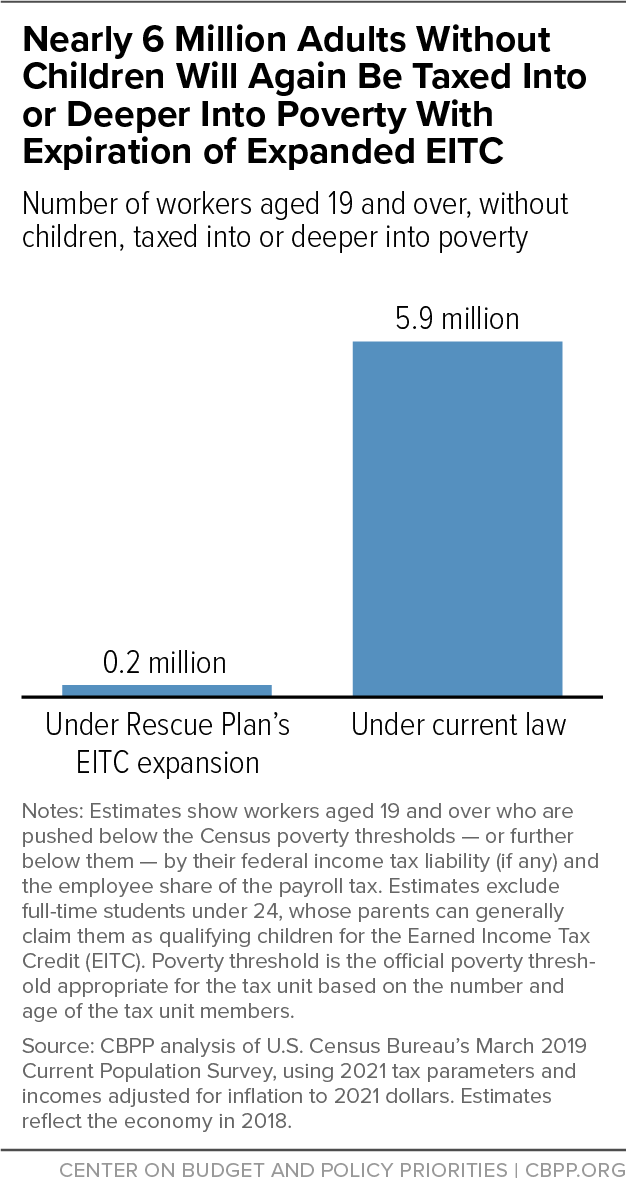
Among those benefiting from the Rescue Plan’s EITC expansions are nearly 6 million working adults aged 19 and older who aren’t caring for children and who will again be taxed into, or deeper into, poverty under current law because their EITC will be zero or paltry. (See graph.) This group includes about 3 million white, 1.3 million Latino, and 1 million Black workers (but excludes full-time students under age 24), many of them young and trying to gain a toehold in the labor market.

To see how the Rescue Plan will help this year at tax time, consider a 25-year-old single woman who worked roughly 30 hours a week throughout 2021 as a child care worker and earned about $9.50 an hour. Her annual earnings of $14,250 were just above the poverty line of $14,097 for a single individual. Without the Rescue Plan, federal taxes would have pushed her into poverty:

  • Some $1,090 — 7.65 percent of her earnings — was withheld from her paychecks for Social Security and Medicare payroll taxes.
  • When filing income taxes, she can claim the $12,550 standard deduction, which leaves her with $1,700 in taxable income. Since she is in the 10 percent tax bracket, she owes $170 in federal income tax.
  • Thus, her combined federal income and payroll tax liability, not counting the EITC, is $1,260. Without the Rescue Plan, she would have received a small EITC of $130, so her net federal income and payroll tax liability would have been $1,130.
  • In other words, although her earnings were just above the poverty line, federal taxes would have pushed her income about $977 below the poverty line.
  • Under the Rescue Plan, her EITC will grow to $1,142, giving her $1,012 more in income after federal income and payroll taxes than she would have had without the Rescue Plan, and keeping her above the poverty line.

This important EITC provision, however, was only the law for 2021, and if Congress fails to act, more than 17 million working people will lose this enhanced wage subsidy at a time when the costs of basic needs are rising. The EITC has long enjoyed bipartisan support, and policymakers should use it not just to stop the federal government from taxing people into poverty but to provide a crucial income boost to people who work important jobs for low pay. The way to ensure that is to extend this critical expansion of the EITC. It’s time for Congress to do just that.

Nearly 11 Million Workers Without Children Are Newly Eligible for Rescue Plan’s Expanded EITC
Workers without children newly eligible due to increased income limit and expanded age range, as well as total eligible
 TotalWhiteBlackLatinoAsianAnother race or multiple races
Newly eligible due to increased income limit
Age 25 to 643,859,0001,879,000688,000969,000195,000128,000
Newly eligible due to expanded age range
Age 19 to 244,790,0002,620,000696,0001,107,000154,000213,000
Age 65 and over2,038,0001,546,000204,000187,00069,00032,000
Total newly eligible10,687,0006,045,0001,588,0002,263,000418,000373,000
Total eligible for expanded EITC17,445,0009,659,0002,739,0003,640,000816,000592,000

Notes: The American Rescue Plan in 2021 increased EITC eligibility for workers without children by raising the income limit to qualify from $15,980 to $21,430 for unmarried filers and from $21,920 to $27,380 for married couples, and by expanding the age range to include younger adults aged 19-24 (excluding students under 24 who are attending school at least part time), and people 65 and over. The number of working adults newly eligible due to the Rescue Plan’s expanded age range includes adults in those age groups whose income falls in the increased income limit range. The Rescue Plan also extends eligibility to former foster youth and youth experiencing homelessness starting at age 18, who are not counted in this table and would make the total number newly eligible slightly higher. Racial and ethnic categories do not overlap; figures for each racial group such as Black, white, or Asian do not include individuals who identify as multiracial or people of Latino ethnicity. Latino includes all people of Hispanic, Latino, or Spanish origin regardless of race. Due to limitations of the Census data, the figures do not reflect IRS rules that require all EITC family members to have a Social Security number. As a result, the Latino figures, in particular, may be somewhat overstated.

Source: CBPP analysis of the March 2019 Current Population Survey allocated by race or ethnicity based on CBPP analysis of American Community Survey data for 2016-2018. Estimates are based on the economy as of 2016-2018 using tax year 2021 tax rules and incomes adjusted for inflation to 2021 dollars.

Thursday, March 31, 2022

112 million Americans struggle to afford healthcare


High prices, low value -- Two new composite scores from West Health and Gallup illustrate America’s healthcare cost crisis


An estimated 112 million (44%) American adults are struggling to pay for healthcare, and more than double that number (93%) feel that what they do pay is not worth the cost. The findings come from two new composite scores developed by the nonprofit, nonpartisan organization West Health and Gallup, the global analytics and advice firm, to assess the healthcare cost crisis.

The West Health-Gallup Healthcare Affordability Index and Healthcare Value Index are drawn from the opinions of more than 6,600 American adults and represent findings from one of the largest surveys fielded during the pandemic on the state of healthcare in America. Each index is comprised of three unique metrics and classifies adults into corresponding categories based on their experiences. The Healthcare Affordability Index assesses the public’s ability to afford the healthcare they need, while the Healthcare Value Index synthesizes Americans’ perceptions of the quality-of-care relative to cost. West Health and Gallup developed these metrics after the rate of Americans reporting skipping needed care due to cost tripled during 2021

“These indices are tracking the healthcare cost crisis in America and its impact on everyday Americans,” said Tim Lash, President of West Health. “Bottom line – Americans are increasingly getting priced out of the system and many of those who can still afford to pay don’t think they’re getting their money’s worth relative to the cost. We must begin to change this trajectory with smarter policies that put patients over profits.”

National health spending is over $4 trillion in this country, and current projections indicate it will continue to grow at an annual rate of 5.4%, topping $6.2 trillion by 2028.

According to the Healthcare Affordability Index, respondents are considered “cost desperate” if they report experiencing three key financial challenges:

  1. Unable to pay for needed medical treatment over the prior three months.
  2. Skipped prescribed medication due to cost over the prior three months.
  3. Unable to afford quality care if it was needed today.

Those classified as “cost insecure” have one or two of these affordability challenges, while cost secure individuals report none of these challenges and are able to consistently access and pay for prescription medications and quality care.

Based on these classifications, 36% of Americans are "cost insecure," 8% are “cost desperate" and 56% are “cost secure.” The likelihood of being cost desperate is more than four times greater for those in households earning under $48,000 per year (13%) compared to those earning $90,000+ per year (3%). Men were more likely to be cost secure than women (60% to 53%) and Hispanic adults were less likely to be cost secure than their Non-Hispanic White counterparts (51% to 58%).

Over one-third (35%) of cost desperate adults report that they have cut back on utilities, and half have cut back on food in the past 12 months to pay for necessary healthcare, rates that are 10 times greater than their cost secure counterparts. Another 14% of this group know a friend or family member who has died in the last 12 months after not receiving treatment due to an inability to pay for it—double the rate of “cost insecure” individuals and seven times greater than “cost secure” individuals.  

Beyond affordability, few Americans believe they get good value when they weigh the quality of their care against the amount that they pay for it. The Healthcare Value Index classifies respondents in the following ways:

  1. “High Perceived Value": These persons (5% of the U.S. adult population) report that both their household and Americans generally are paying the right amount (or too little) relative to the quality of care they receive and that their most recent care experience was worth the cost.
  2. "Inconsistent Perceived Value": These persons (50% of the U.S. adult population) report that either their household or Americans generally are paying too much for the quality of the care that they receive or that their most recent care experience was not worth the cost.
  3. "Poor Perceived Value": These persons (45% of the U.S. adult population) report that both their household and Americans generally are paying too much for the quality of the care they receive and that their most recent care experience was not worth the cost.

“These estimates are important resources for policymakers, researchers, and the public to evaluate and understand the burden of high healthcare costs,” said Dan Witters, a senior researcher for Gallup. “The indices paint a comprehensive picture of why Americans are unable to keep pace with the rising costs and don't see value in the care they are receiving.”


Methodology

The results are based on a nationally representative survey conducted by web over successive field periods of Sept. 27-30 and Oct. 18-21 of 6,663 American adults aged 18 and older, living in all 50 U.S. states and the District of Columbia, as a part of the Gallup Panel. For results based on these monthly samples of national adults, the margin of sampling error at the 95% confidence level is +1.5 percentage points. For reported subgroups, such as by age, political identity, household income or race/ethnicity, the margin of error is larger, typically ranging from ±3 to ±5 percentage points.
 

Wednesday, February 9, 2022

What a great idea: Creating a state-level child tax credit

 Connecticut Voices For Children

Complete report :"The Case For The Connecticut Child Tax Credit." http://ow.ly/2io050HPuZo

As addressed a recent tax report—“Steps To A Fairer Tax System”—half of Connecticut’s families in 2021 had difficulty paying their usual expenses (e.g., food, housing, utilities).1 The problem has continued in 2022 and appears to be getting worse. In January, 53 percent of the state’s families had difficulty paying their usual expenses, and the percentage was even higher for certain subgroups, especially working-class and lower-middle-class families (78 percent and 62 percent), Black and Latino/a/x families (77 percent and 74 percent), and families with children (65 percent).

Income inequality and the racial income gap make it difficult for working- and middle-class families, especially families of color, to make ends meet; and over time, through both the “investment” and “stress” pathways, income inequality and the racial income gap negatively impact the children from working- and middle-class families, especially families of color, in “virtually every dimension, from physical and mental health, to educational attainment and labor market success, to risky behaviors and delinquency.”

These problems in turn weaken Connecticut’s economy and thereby decrease the state’s ability to make critical investments and pay down long-term obligations, which ultimately hurts all of the state’s families. 

The recent report cited above showed that Connecticut’s approach to taxation contributes to the above problems. The report also showed that making Connecticut’s tax system fairer requires tax reform, transparency, and timely support, all of which, in simple terms, would put more money in the pockets of working and middle-class families, especially families of color.

This companion report provides a detailed overview of one especially problematic component of the tax system: Connecticut is the only high cost of living state in the U.S. with an income tax that does not adjust for family size or child care expenses, which makes the state’s unfair tax system even more unfair for working- and middle-class families with children, especially those that require child care. 

In addition to making it harder for families with children to make ends meet compared to the average family, the lack of tax support for the high and growing cost of raising children directly contributes to the state’s slow economic growth by slowing the state’s population growth, which is a function of both a declining natural rate of population change (i.e., the birth rate minus the death rate) and a negative net migration rate (i.e., the number of families moving to the state minus the number of families leaving).

Property tax reform urgently needed in Connecticut

 Connecticut has a rare opportunity, due to its positive budget situation, to correct the greatest inadequacy and inequity in its tax structure: the longstanding over-reliance on the local property tax. Property tax reform should be focused on correcting the serious flaws associated with this tax; which now constitutes the major source of funding for municipalities, and makes up 41.9% of the total tax burden for Connecticut residents. 

There are two fundamental flaws in Connecticut’s property tax system. (1) Horizontal inequity: owners of property with similar values are taxed at different rates depending on which town they live in, and owners paying similar tax rates receive widely different services. (2) Vertical inequity: low- and moderate-income households are subjected to far higher effective property tax rates than high-income households. 

Property tax reform must be done in a way that corrects these structural flaws. If we fail to correct both the vertical and horizontal inequities, we will continue down a path of widely disparate educational opportunity, fractured and inefficient delivery of needed services, hollowed out cities, widening racial and economic disparities, sprawling suburbs, fleeing businesses and an out-migration of the next generation of talent. 

Complete report

Monday, February 7, 2022

Midterms optimism and “When are we going to start hitting Republicans?"

 KRISTIAN RAMOS of Autonomy Strategies said he’s “more optimistic than others.” He said the “economy is incredible” and Democrats will have a better story to tell about the Biden record this year if they pass some version of Build Back Better, get children under 5 vaccinated, confirm the first Black woman to the Supreme Court and highlight the implementation of the infrastructure law.

But he’s bewildered by what he sees as his party’s restraint when it comes to attacking the GOP. “When are we going to start hitting Republicans?” he asked. “When are we going to start pointing out these people are fascist light and don’t believe in democracy?”

Friday, February 4, 2022

The Republican Party declared the deadly January 6th Capitol attack “legitimate political discourse.”


Today, the Republican Party formally passed a resolution declaring the deadly January 6th Capitol attack “legitimate political discourse.” The Party also censured Reps. Adam Kinzinger and Liz Cheney, the two Republicans serving on the January 6th committee investigating the riot. RNC Chairwoman Ronna McDaniel doubled down on the resolution in a statement, claiming Kinzinger and Cheney are engaging in a “persecution of ordinary citizens who engaged in legitimate political discourse.”
Yes: according to the Republican Party, sending lawmakers running for their lives and chanting about hanging the Vice President is simply “legitimate political discourse.” Trump is running in 2024. State Republicans are suppressing the vote and gerrymandering their way back into power. The entire party is beholden to the Big Lie. Make no mistake: the GOP is dragging us into outright fascism. Democrats must take this threat seriously — before it’s too late.

As the RNC reframes the unlawful attempt to overturn the election of President Biden as “legitimate,” we again call for the CT GOP, Bob Stefanowski, and all other CT Republican candidates to condemn Trump’s incitement of the riot.